
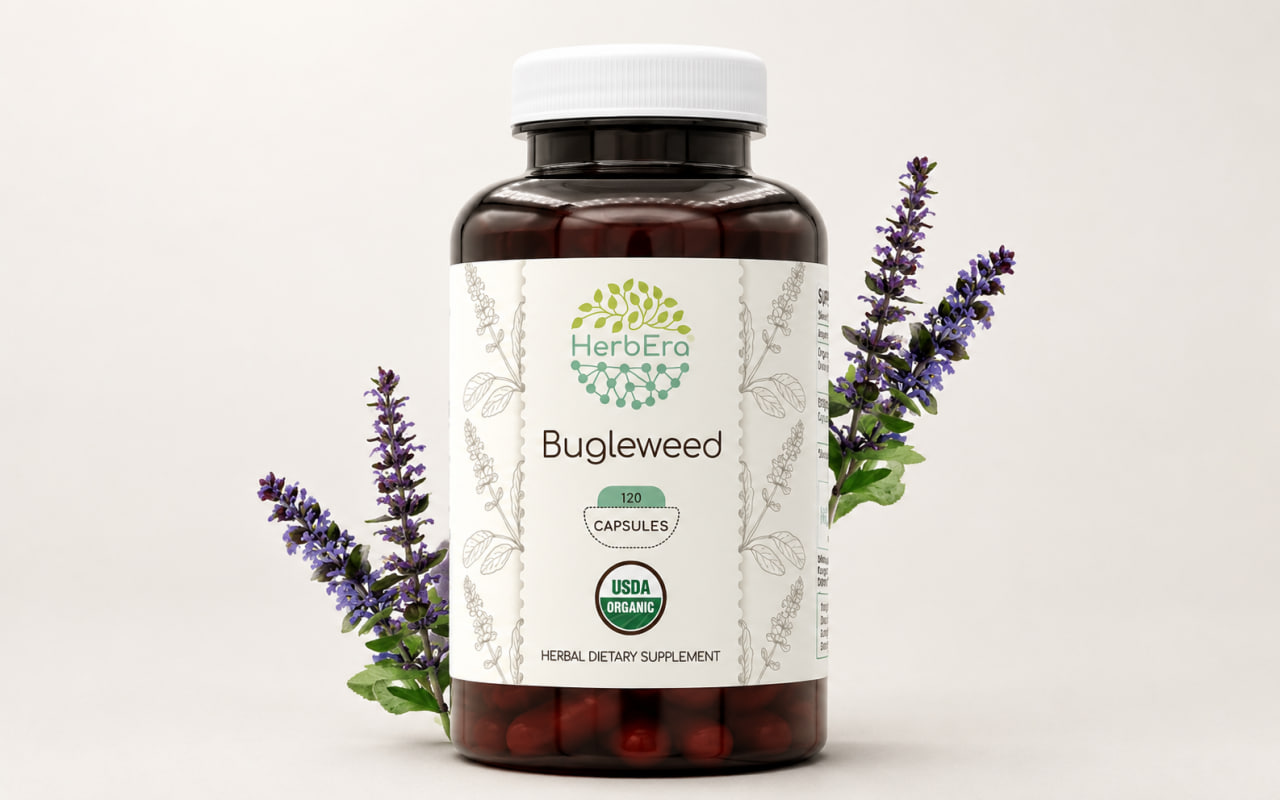
Lycopus Virginicus vs Lycopus Europaeus is a label question that matters when you are comparing bugleweed capsules. Many shoppers see the common name “bugleweed” and assume every product uses the same ingredient. That is not always true. One bottle may list Lycopus virginicus. Another article may discuss Lycopus europaeus. A marketplace listing may say only “bugleweed herb” or “Lycopus spp.”
That difference can create confusion, especially if you are checking a supplement against something you read about thyroid-related herbs. HerbEra’s bugleweed capsule context is a useful reminder: the botanical name and plant part should be checked before you assume two products or articles are talking about the exact same ingredient.
This guide explains how Lycopus virginicus and Lycopus europaeus differ on labels, why the common name bugleweed is not enough, what “dried herb” means, and what to ask before buying or using bugleweed capsules.
Are Lycopus Virginicus and Lycopus Europaeus the Same Bugleweed?
No. Lycopus virginicus and Lycopus europaeus are related species in the Lycopus genus, but they are not the same species. Both may be called bugleweed in herbal contexts, which is why common names can confuse shoppers.
Lycopus virginicus is often associated with names such as Virginia bugleweed or American bugleweed. Lycopus europaeus is often associated with European bugleweed or gypsywort. Depending on the source, both may appear in thyroid-related herbal discussions.
The practical answer
If your capsule label says Lycopus virginicus, do not assume it is the same as an article about Lycopus europaeus. They belong to the same genus, but the species name tells you which plant the product claims to use.
When comparing labels, always check the full botanical name, not just the word bugleweed.
Why Botanical Name Matters More Than Common Name
Botanical names matter because common names can overlap. “Bugleweed” can refer to more than one Lycopus species, and in some contexts it may even be confused with unrelated plants that share similar common-name wording.
A botanical name is more precise. Lycopus is the genus. Virginicus or europaeus is the species. Together, the two-word name identifies the plant more clearly than the common name alone.
How to read the two-word name
In Lycopus virginicus, “Lycopus” is the genus and “virginicus” is the species. In Lycopus europaeus, “Lycopus” is the genus and “europaeus” is the species.
If a label gives only “Lycopus spp.,” it means the species is not specified. That may be acceptable for some buyers, but it is not ideal when you want to match the product to a specific source or article.
Lycopus Virginicus vs Lycopus Europaeus: Quick Comparison
The simplest way to compare the two is to separate the common name, botanical name, likely label wording, and what not to assume.
| Label or source term | What it means | What to check |
|---|---|---|
| Lycopus virginicus | A specific Lycopus species often called Virginia or American bugleweed | Plant part, form, serving size, warnings |
| Lycopus europaeus | A specific Lycopus species often called European bugleweed or gypsywort | Whether the product label matches the article source |
| Bugleweed | A common name that may refer to different Lycopus species | Botanical name and plant part |
| Lycopus spp. | Unspecified species within the Lycopus genus | Ask the brand which species is used |
| Dried herb | Dried above-ground plant material, depending on label wording | Whether it means aerial parts, leaf, flowering tops, or another part |
| Extract | A concentrated preparation rather than plain powder | Extract ratio, plant part, solvent, and species |
A specific botanical name makes comparison easier. Vague common-name wording creates more uncertainty.
What Does “Bugleweed” Mean on a Capsule Label?
On a capsule label, “bugleweed” is the common name. It does not always tell you the exact species, plant part, or preparation type. A stronger label should include both the common name and the botanical name.
For example, “Bugleweed herb (Lycopus virginicus)” is clearer than “Bugleweed.” “Lycopus europaeus extract” is clearer than “Lycopus extract” because it identifies the species.
Common-name problem
Common names are useful for shoppers, but they are not precise enough for careful supplement comparison. Several plants can share similar names across regions, traditions, or marketplaces.
When a product is used in a health-related context, precision matters. Do not rely on the front label alone.
What Does “Dried Herb” Mean?
“Dried herb” usually means dried plant material, often the above-ground part of the plant. In herbal labeling, this may overlap with terms such as aerial parts, herb, leaf, flowering tops, or whole herb. The exact meaning depends on the label and manufacturer.
If your capsule says Lycopus virginicus dried herb, it may not be the same as a liquid extract made from Lycopus europaeus. Species, plant part, and format are all part of the identity.
Plant part matters
For bugleweed capsules, look for herb, aerial parts, leaf, flowering tops, dried herb, powder, or extract. These terms help you understand what is inside the capsule.
If the plant part is missing, ask the brand before assuming what was used.
Capsule Powder vs Extract: Why the Form Matters
A capsule can contain dried herb powder, extract powder, or a blend. These are not the same. Dried herb powder is usually ground plant material. Extract powder is made through an extraction process and may be concentrated.
Two products can both list bugleweed but still differ in form, serving size, concentration, and label directions.
| Format | What it usually means | What to ask |
|---|---|---|
| Dried herb powder | Ground dried plant material | Which species and plant part? |
| Extract powder | Concentrated preparation from plant material | What extract ratio and solvent? |
| Whole herb | May mean broad above-ground plant material | Does this mean aerial parts? |
| Proprietary blend | Formula with multiple ingredients listed together | How much bugleweed is included? |
| Single-ingredient capsule | One main botanical ingredient | Is the species clearly named? |
If you are comparing Lycopus virginicus vs Lycopus europaeus, format must be part of the comparison. Species alone does not tell the whole story.
How to Tell Which Bugleweed Is in Your Capsules
Start with the Supplement Facts panel. Look for the botanical name, common name, plant part, form, serving size, and amount per serving. Then check the product description and bottle images for matching wording.
If the label says Lycopus virginicus dried herb, that is more specific than a product that says only bugleweed. If the label says Lycopus europaeus extract, it is a different species and a different form.
Best label wording
A clear label might say “Bugleweed herb (Lycopus virginicus) dried herb powder.” Another clear label might say “Lycopus europaeus aerial parts extract.”
A weak label might say only “bugleweed capsules.” That wording is too vague for species-level comparison.
Why Articles May Discuss Lycopus Europaeus While Products Use Lycopus Virginicus
Articles and supplement products do not always focus on the same species. Some herbal references discuss Lycopus europaeus because it is a well-known European species. Some North American products may use Lycopus virginicus. Marketplaces may simplify both into “bugleweed.”
This is why a shopper can read about one species and then find a product using another. The common name creates the bridge, but the botanical name reveals the difference.
Do not transfer details automatically
Do not assume a statement about Lycopus europaeus applies exactly to Lycopus virginicus capsules. Related species may be discussed together, but a product decision should use the exact label.
When health context matters, ask a qualified healthcare professional to review the specific product.
What If the Label Says Only “Lycopus spp.”?
“Lycopus spp.” means the label identifies the genus but not the species. It may be used when more than one species could be included or when the seller has not specified which species is used.
If you need to know whether the product is Lycopus virginicus or Lycopus europaeus, “Lycopus spp.” is not enough.
What to ask the brand
Ask: “Which Lycopus species is used in this product?” Ask: “Is it Lycopus virginicus, Lycopus europaeus, or another species?” Ask: “Which plant part is used?” Ask: “Is the ingredient dried herb powder or extract?”
A clear answer should identify species, plant part, and form.
Why This Matters for Thyroid-Related Searches
Bugleweed is often searched in thyroid-related contexts, but that does not mean shoppers should self-select a product by species name alone. Thyroid medication, thyroid diagnosis, lab values, pregnancy, nursing, and other supplements can all change the safety conversation.
If you take thyroid medication or have a thyroid disorder, ask a qualified healthcare professional before using bugleweed capsules. Bring the exact label. Do not rely on common-name matching.
No thyroid self-management
Bugleweed capsules should not be used to treat, cure, prevent, diagnose, reverse, detox, cleanse, flush, or manage a thyroid condition.
Do not start, stop, or change thyroid medication because of a bugleweed article, product listing, or customer review.
What to Compare Before You Buy
Before buying, compare the species, plant part, format, serving size, warnings, capsule ingredients, testing information, lot number, expiration date, and seller clarity.
Do not compare only price or capsule count. A 100-capsule bottle of unspecified bugleweed is not the same as a 100-capsule bottle that clearly lists Lycopus virginicus dried herb.
Marketplace listing vs bottle label
Marketplace titles are often shorter than full labels. A listing might say bugleweed capsules while the bottle image shows Lycopus virginicus. Another listing might copy generic text from a Lycopus europaeus article.
HerbEra’s marketplace-style label context shows why bottle images and Supplement Facts matter more than short product titles.
What Are Red Flags on a Bugleweed Capsule Label?
A red flag does not always mean the product is poor quality. It means you need clarification before buying or using it.
Red flags include no botanical name, no plant part, no serving amount, unclear species, no Supplement Facts image, conflicting marketplace copy, vague proprietary blend, missing warnings, missing lot number, unreadable expiration date, or broad medical claims.
Be cautious with disease claims
A bugleweed capsule listing should not promise thyroid results or imply that it can replace medical care. Avoid products that make strong disease claims or encourage medication changes.
Safer labels focus on ingredient identity, suggested use, warnings, and quality information.
Questions to Ask Before Buying
Ask direct questions if the label is unclear. The seller should be able to identify the species, plant part, and product format.
Good questions save time and reduce the risk of buying a product that does not match the article or ingredient you intended to compare.
Useful questions
Ask: “Is this product made with Lycopus virginicus or Lycopus europaeus?” Ask: “What plant part is used?” Ask: “Is it dried herb powder or an extract?” Ask: “Does the current bottle label show the species name?”
If you have thyroid history or take medication, ask your pharmacist or clinician: “Does this exact bugleweed product fit my current plan?”
Checklist: How to Read a Bugleweed Capsule Label
Use this checklist before comparing Lycopus virginicus vs Lycopus europaeus. It helps you move from vague common names to precise label facts.
Find the botanical name
Look for Lycopus virginicus, Lycopus europaeus, or another Lycopus species. Do not rely only on the word bugleweed.
Check the plant part
Look for herb, aerial parts, leaf, flowering tops, dried herb, or extract. Ask the brand if the plant part is missing.
Identify the format
Check whether the capsule contains dried herb powder, extract powder, or a blend. Powder and extract are not the same.
Compare the article to the label
If an article discusses Lycopus europaeus and your bottle says Lycopus virginicus, do not assume the information matches exactly.
Review serving directions
Check capsule count, amount per serving, frequency, and warnings. Do not create your own serving plan.
Check medication context
Ask a qualified healthcare professional before use if you take thyroid medication or have thyroid history.
Look for label red flags
Pause if there is no species, no plant part, no Supplement Facts image, vague blend wording, or broad medical claims.
Ask the seller directly
Ask for the current species, plant part, and form if the marketplace listing is unclear or conflicts with the bottle image.
FAQ
Are Lycopus virginicus and Lycopus europaeus the same?
No. They are related Lycopus species, but they are not the same species.
Can both be called bugleweed?
Yes. Both may be called bugleweed in herbal contexts, which is why the botanical name matters.
Which bugleweed is in my capsules?
Check the Supplement Facts panel and bottle label for Lycopus virginicus, Lycopus europaeus, or another species name.
What does Lycopus spp. mean?
It means an unspecified species within the Lycopus genus. Ask the brand which species is used.
What does dried herb mean?
Dried herb usually means dried plant material, often above-ground parts, but the label should clarify the plant part.
Is bugleweed extract the same as dried herb powder?
No. Extract and dried herb powder are different formats and should not be compared as if they are identical.
Can I use information about Lycopus europaeus for Lycopus virginicus?
Do not assume an exact match. Related species may overlap in discussions, but product decisions should use the exact label.
Why is the botanical name important?
The botanical name identifies the species more precisely than the common name bugleweed.
Should I ask before using bugleweed with thyroid medication?
Yes. Ask a qualified healthcare professional before using bugleweed if you take thyroid medication or have thyroid history.
Glossary
Bugleweed
A common name used for certain Lycopus species in herbal supplement contexts.
Lycopus
The botanical genus that includes species such as Lycopus virginicus and Lycopus europaeus.
Lycopus virginicus
A Lycopus species often associated with names such as Virginia bugleweed or American bugleweed.
Lycopus europaeus
A Lycopus species often associated with names such as European bugleweed or gypsywort.
Water horehound
A common-name phrase sometimes used for plants in the Lycopus genus.
Dried herb
Dried plant material used in capsules, powders, teas, or extracts, often referring to above-ground parts.
Aerial parts
The above-ground parts of a plant, such as stems, leaves, and flowering tops.
Extract
A preparation made by extracting plant material with a solvent, then using the resulting liquid or dried extract.
Single-ingredient capsule
A capsule product that uses one main botanical ingredient instead of a multi-herb blend.
Supplement Facts
The label panel that lists serving size, dietary ingredients, and amounts per serving for a supplement.
Conclusion
Lycopus Virginicus vs Lycopus Europaeus comes down to species-level label reading. Check the botanical name, plant part, format, serving directions, and warnings before assuming a bugleweed capsule matches what you read in an article.
Sources Used
Botanical identity and taxonomic reference for Lycopus virginicus, Lycopus virginicus plant profile – Plants of the World Online
Botanical identity and taxonomic reference for Lycopus europaeus, Lycopus europaeus plant profile – Plants of the World Online
General bugleweed supplement overview and safety context, Bugleweed Overview – WebMD
Consumer guidance on supplement use and label reading, Dietary Supplements: What You Need to Know – NIH Office of Dietary Supplements
General dietary supplement labeling guidance, Dietary Supplement Labeling Guide – FDA
General botanical supplement safety context, Botanical Dietary Supplements – National Center for Complementary and Integrative Health